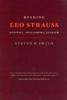
Interest in Leo Strauss is greater now than at any time since his death, mostly because of the purported link between his thought and the political movement known as neoconservatism. Steven B. Smith, though, surprisingly depicts Strauss not as the high priest of neoconservatism but as a friend of...
A rediscovery of patriotism as a virtue in line with the core values of democracy in an extremist age.
The concept of patriotism has fallen on hard times. What was once a value that united Americans has become so politicized by both the left and the right that it threatens to rip apart the social...
Most readers of Spinoza treat him as a pure metaphysician, a grim determinist or a stoic moralist, but none of these descriptions captures the author of the “Ethics”, argues Steven Smith in this book. Offering a new reading of Spinoza’s masterpiece, Smith asserts that the “Ethics” is a...
Baruch de Spinoza (1632-1677)—often recognized as the first modern Jewish thinker—was also a founder of modern liberal political philosophy. This book is the first to connect systematically these two aspects of Spinoza’s legacy. Steven B. Smith shows that Spinoza was a politically engaged...
Isaiah Berlin (1909–1997) was a central figure in twentieth-century political thought. This volume highlights Berlin’s significance for contemporary readers, covering not only his writings on liberty and liberalism, the Enlightenment and Romanticism, Russian thinkers and pluralism, but also...
Leo Strauss was a central figure in the 20th century renaissance of political philosophy. The essays of The Cambridge Companion to Leo Strauss provide a comprehensive and non-partisan survey of the major themes and problems that constituted Strauss’s work. These include his revival of the great “...
Abraham Lincoln never wrote a book: his ideas are contained in speeches, letters, and various occasional writings. By bringing these works together into a single anthology, this book shows that Lincoln deserves to be counted among the great political philosophers.
In addition to many examples of...
When civil war came to Mogadishu, the capital of Somalia, in January 1991, two-thirds of the city’s population fled. Among them was eight-year-old Asad Abdullahi. His mother murdered by a militia, his father somewhere in hiding, he was swept alone into the great wartime migration that scattered the...
On Park Hill Avenue in New York City, almost everyone is Liberian. Most people know one another; if not by name, then by face. And yet neighbours do not ask one another what they did in Liberia, for the question is considered an accusation. Many people here fled Liberia’s brutal civil war, a...
In the spring of 1999, in the beautiful hills of the KwaZulu-Natal midlands, a young white farmer was shot dead on the dirt road running from his father’s farmhouse to his irrigation fields. The murder was the work of assassins rather than robbers; a single shot behind the ear, nothing but...