
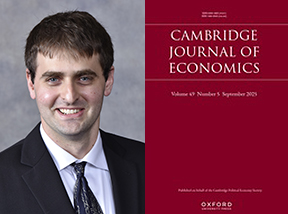
Lecturer in Ethics, Politics and Economics Gregory Collins has an article on Cambridge Journal of Economics entitled “The Influence of Burke in the Thought of Keynes and Hayek.”
Abstract:
Edmund Burke attracted the interest of both F.A. Hayek and John Maynard Keynes, even though the two economists often clashed on many vital questions over economic policy throughout the twentieth century. My paper seeks to explain this convergence in their thought by employing Tony Lawson’s framework of social ontology. It argues that Hayek’s and Keynes’ shared affinity for Burke generally derived from their attraction to the expedient and utilitarian dimensions of his political theory and to his sharp resistance to political rationalism. Even with their intellectual tensions, Hayek’s and Keynes’ attraction to the anti-revolutionary and utilitarian strands of Burke’s political theory was rooted in their sensitivity to the complicated nature of social reality that, in their view, escaped the powers of formal deduction. As a guiding principle of the heterodox turn toward social ontology in economics, this belief can be traced back to Burke’s attack on the tendency among elite contemporaries in the eighteenth century to quantify and rationalize the deep complexities of society. I conclude, however, by suggesting that both Keynes and Hayek were not able to escape the economistic outlook they otherwise decried. This outlook requires Burke’s broader notion of social ontology to protect against its gravest vulnerability—the absence of a moral imagination.